
LLM SEO: Preparing for Search Beyond Google
Why visibility now depends on becoming a trusted reference, not a top result

Most teams still think SEO is about winning inside Google’s interface.
The next wave of visibility will not start inside a search box.
It will start inside AI systems that summarize, infer, recommend, and cite sources directly.
I have been talking about this shift since the rise of SGE and Bing Chat.
Generative systems are not just ranking pages.
They are extracting meaning, comparing sources, and resolving intent faster than a human can type the query.
This is why “think like a search engine” matters even more now.
In local SEO, LLMs reward clarity, specificity, consistent signals, and structured data that travels cleanly across multiple contexts without losing brand voice and readability.
I'm not saying LLMs use schema markup in ranking answers (though they might someday).
When a model quotes a source, it needs confidence that your page is the most complete, precise, and experience-backed reference for that intent.
We have already seen this in practice.
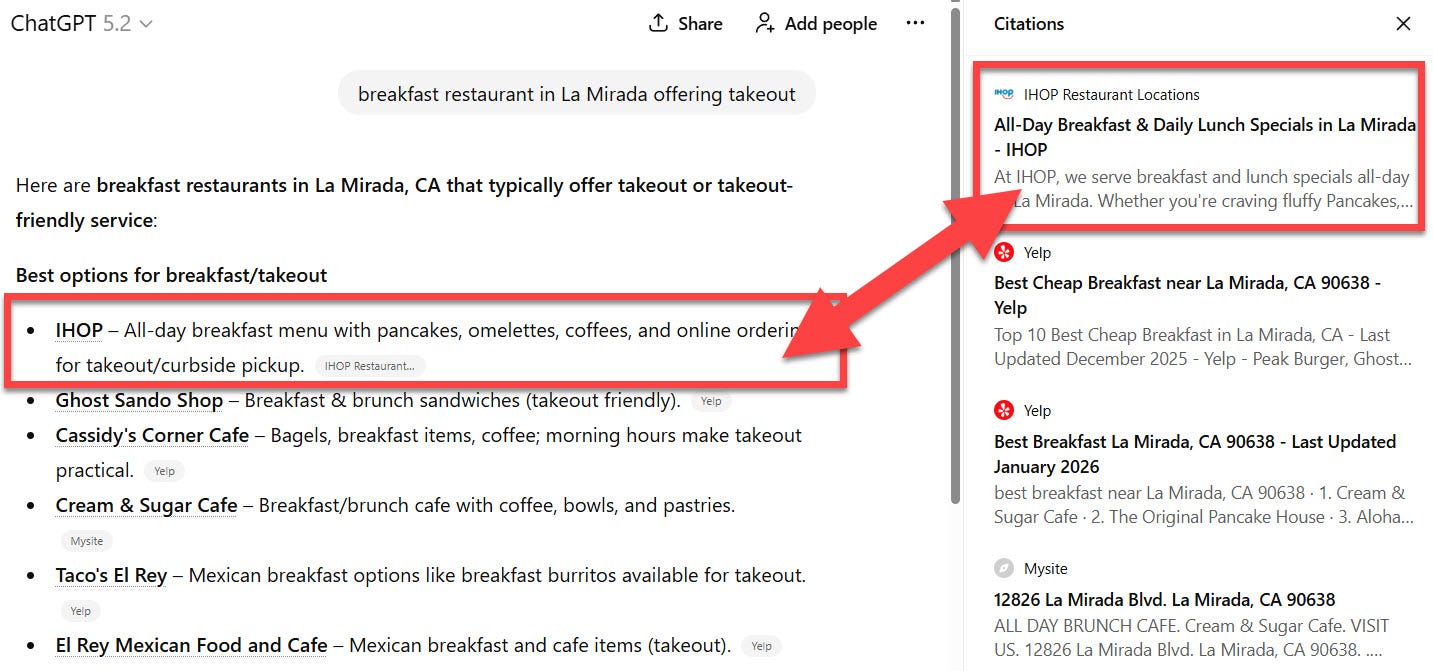
The takeout and delivery intent pages we launched for IHOP and Applebee’s during the pandemic now appear as cited sources in systems like ChatGPT and Perplexity. Try it yourself: "breakfast restaurant in [your_city] offering takeout."
The same is true for structured service pages at Meineke Care Centers that were built around real services and real demand.
When the content reflects what actually happens at the location, those pages surface more often across queries and assistants.
Behind the scenes, this type of performance came from groundwork that had nothing to do with AI.
It came from topic gap analysis that uncovered terms like “storage units” for Public Storage, from manual reviews of 300 location pages to decide what felt helpful versus distracting, and from repeated tests that aligned pages with real customer questions.
This is the direction we are heading.
Google is one surface, but it is slowly becoming just one of many.
LLMs pull from the wider web. They cite what they trust.
They cite pages that show depth. They cite sources that solve the problem faster and more clearly than the alternatives.
The future of SEO is not “beat the SERP.”
It is about becoming reference material worth citing by the systems that interpret the SERP for the user.
What are you currently doing to shape the discoverability landscape of your products and services beyond Google?